
 EN
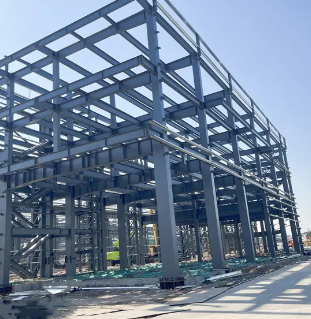
Reduced Embodied Carbon Through Efficient Fabrication and Material Use
Factory-controlled precision cutting and assembly minimizing waste and on-site emissions
The factory-controlled fabrication of a pre-engineered steel building (PEB) fundamentally reduces embodied carbon by shifting construction from chaotic job sites to digitally driven manufacturing environments. Components are cut to exact tolerances using CNC plasma, laser, and robotic welding systems that optimize nesting patterns—achieving up to 95% material utilization on a single steel plate. Remaining offcuts are segregated and recycled directly into the steel supply chain, avoiding the mixed-waste streams typical of conventional builds. Because elements arrive as finished assemblies—not raw stock—on-site cutting, drilling, and grinding are virtually eliminated, drastically reducing PM2.5 and CO2 emissions from diesel-powered equipment. A 2018 meta-analysis of building life-cycle assessments found prefabrication alone yields a 15.6% embodied carbon reduction, driven primarily by factory precision and just-in-time delivery. For PEBs, further gains come from engineered cold-formed profiles that use less steel to carry identical loads—cutting transport weight and fuel use while preserving full recyclability at end-of-life.
Lifecycle analysis: PEB vs. conventional concrete structures in carbon footprint and resource intensity
Lifecycle assessments consistently show that PEBs outperform conventional reinforced-concrete frames in both carbon footprint and resource intensity. Steel’s high strength-to-weight ratio allows PEBs to carry equivalent loads with 30–50% less structural mass—reducing the volume of carbon-intensive cement required in foundations and slabs. Even when comparing a PEB warehouse to a concrete-framed alternative, the embodied carbon of the steel structure is typically 20–30% lower per square meter (2022 industry benchmarking data). In operational phases, the lighter envelope lowers heating and cooling demand, while steel itself functions as a durable material bank: over 90% of structural steel is recovered and recycled without loss of properties—a cradle-to-cradle advantage concrete cannot match, as it is generally down-cycled into low-value aggregate. When optimized fabrication, modular delivery, and end-of-life reuse align—as in certified green-building projects—these advantages combine to deliver up to a 42% lifecycle carbon reduction over 30 years.
Enhanced Operational Energy Efficiency of Pre-Engineered Steel Building Envelopes
Beyond low embodied carbon, a pre-engineered steel building’s real-world environmental performance depends on how efficiently it consumes energy day after day. Tailored envelope design directly cuts heating and cooling loads, delivering measurable operational savings.
High-performance insulation integration and thermal bridging mitigation in PEB designs
Modern PEB envelopes integrate continuous insulation systems—such as insulated metal panels—to significantly reduce thermal conductivity. Because steel framing is inherently conductive, unchecked thermal bridging can drain up to 30% of a building’s heating energy (U.S. Department of Energy, 2023). PEB designs counter this with thermal break tapes placed between purlins and exterior sheeting, decoupling interior comfort from exterior temperature swings. Factory-fabricated panels with polyurethane or mineral wool cores achieve R-values of R-30 or higher while eliminating gaps that cause air leakage. Sealed joints further prevent uncontrolled infiltration, keeping conditioned air inside. The result is a stable indoor thermal environment requiring far less HVAC runtime—directly lowering operating costs and carbon emissions over the building’s lifetime.
Modular scalability supporting passive design, daylighting, and future net-zero retrofits
The modular frame of a pre-engineered steel building enables clean spans of up to 300 feet, giving architects flexibility to orient the structure for optimal passive solar gain. Large, uninterrupted wall and roof areas accommodate clerestory windows and skylights that harvest daylight—reducing lighting energy use by up to 75% (Lawrence Berkeley National Laboratory, 2022). This scalability also supports straightforward integration of renewable energy systems later in the building’s life: photovoltaic arrays, wind turbines, or geothermal borefields can be added without altering the structural skeleton. Simple sustainability upgrades—like positioning personnel doors away from prevailing winds or adding sun-shading overhangs—are made easy by pre-drilled steel connections. And because PEB expansions are bolt-on, future retrofits avoid demolition waste, preserving the building’s low whole-life footprint. Such future-proofing makes the PEB envelope a strategic asset for long-term sustainable operations.
Advancing Decarbonisation via Low-Carbon Steel Production and Circular Practices
Growing adoption of EAF recycling and green hydrogen DRI in pre-engineered steel building supply chains
Steel production accounts for roughly 7% of global CO₂ emissions—but supply chains for pre-engineered steel buildings are rapidly shifting toward low-carbon methods. Electric Arc Furnace (EAF) technology, which melts recycled scrap, uses up to 75% less energy than traditional blast furnaces and cuts direct emissions by about 60% (World Steel Association, 2024). Meanwhile, green hydrogen-based Direct Reduced Iron (DRI) is emerging as a breakthrough pathway to produce primary steel with near-zero process emissions. Several pilot plants in Europe and Asia now operate on 100% hydrogen, and the global EAF production share is projected to reach 50% by 2030. These advancements mean the steel framing, roofing, and panels used in PEBs increasingly originate from mills committed to decarbonisation—shrinking embodied carbon before construction begins.
End-of-life recyclability and design-for-disassembly as inherent sustainability advantages
Steel is the world’s most recycled material—and a pre-engineered steel building is inherently designed for circularity. Unlike welded conventional structures, PEBs rely on bolted connections that allow components to be quickly disassembled, relocated, or repurposed without damage. This design-for-disassembly eliminates demolition waste and keeps materials in the value chain. Recycling 1 kg of steel saves approximately 1.5 kg of CO₂-equivalent emissions and 1.4 kg of iron ore (Broadbent, 2016), while retaining all mechanical properties indefinitely. At end-of-life, nearly 100% of the structural steel can be fed back into EAFs to create new products—closing the loop. Combined with standardized modular components, this circular model dramatically reduces both short-term construction waste and long-term resource depletion, making PEBs a cornerstone of sustainable building.
Proven Environmental Impact Reduction: Real-World Green Building Performance
LEED-NC certified pre-engineered steel building warehouse: 42% lifecycle carbon reduction over 30 years
A LEED-NC (New Construction) certified warehouse built with pre-engineered steel building methods achieved a 42% reduction in lifecycle carbon emissions over 30 years compared to a concrete-steel hybrid baseline. This outcome reflects integrated eco-design: factory-controlled steel fabrication reduced raw material scrap to under 2%, while the airtight, highly insulated envelope and cool roof coatings cut annual cooling energy by 15% (Lawrence Berkeley National Lab, 2023). The steel frame was produced with over 90% recycled content using electric arc furnace (EAF) technology—slashing upfront embodied carbon. Designed for disassembly, the structure enables component reuse and ensures 100% steel recyclability at end-of-life. Operational energy use aligns with broader LEED performance benchmarks: certified buildings typically consume 25% less energy and emit 34% less CO₂ than conventional structures (USGBC, 2023). This case confirms that pre-engineered steel construction transforms material efficiency, thermal performance, and circularity into verifiable, long-term environmental gains.
FAQ Section
What are pre-engineered steel buildings (PEBs)?
Pre-engineered steel buildings are structures fabricated in controlled factory environments using precision technologies. Components are manufactured to exact specifications and assembled on-site.
How do PEBs reduce embodied carbon?
PEBs minimize embodied carbon by utilizing precise fabrication methods, optimizing material use, reducing waste, and incorporating recyclable components.
What advantages do PEBs have over traditional reinforced concrete structures?
PEBs use less structural mass, have lower embodied carbon, support modular scalability, and offer superior recyclability compared to conventional concrete buildings.
How do PEBs enhance operational energy efficiency?
PEBs incorporate features like high-performance insulation, thermal bridging mitigation, and modular scalability to reduce heating and cooling needs and increase energy efficiency.
What sustainability practices do PEB supply chains follow?
PEB supply chains increasingly use low-carbon steel methods like electric arc furnace (EAF) recycling and green hydrogen-based direct reduced iron (DRI) production.
Table of Contents
- Reduced Embodied Carbon Through Efficient Fabrication and Material Use
- Enhanced Operational Energy Efficiency of Pre-Engineered Steel Building Envelopes
- Advancing Decarbonisation via Low-Carbon Steel Production and Circular Practices
- Proven Environmental Impact Reduction: Real-World Green Building Performance
- FAQ Section