 EN
EN
Superior Structural Capacity for Heavy Loads
High-Yield Steel Grades (Q355, S355JR, ASTM A572) and Their Role in Load-Bearing Integrity
Steel workshops designed for heavy-load industrial production rely on high-yield steel grades to achieve exceptional load-bearing integrity without excessive bulk. Q355 (China), S355JR (Europe), and ASTM A572 Grade 50 all deliver minimum yield strengths of 345–355 MPa—well above the 235 MPa typical of mild steel. This enhanced strength enables lighter, more economical frameworks: a steel workshop using Q355 can reduce overall steel tonnage by up to 20% compared to conventional mild-steel designs, per the American Institute of Steel Construction (AISC, 2023). The higher yield point also improves resistance to plastic deformation under peak loads—critical when supporting overhead cranes and heavy machinery—ensuring long-term dimensional stability. Additionally, these grades combine excellent weldability and ductility, facilitating efficient fabrication and reliable on-site assembly while maintaining rigorous safety margins. Selecting the right high-yield steel thus delivers optimal balance among structural capacity, service life, and material economy.
Fatigue Resistance vs. Tensile Strength: Optimizing Steel Workshop Design for Crane-Intensive Environments
In crane-intensive operations, fatigue resistance—not just tensile strength—dictates structural longevity. While tensile strength ensures a structure withstands occasional maximum loads, it is the millions of cyclic stresses from repeated crane motions that drive cumulative damage. Fatigue cracks typically initiate at stress concentrations such as weld toes or abrupt section changes; Eurocode 3 (2022) notes that even a detail rated for 200 MPa static tension may require limiting the stress range to just 160 MPa for two million cycles. Therefore, optimizing for crane use means prioritizing fatigue-critical detailing: smooth transitions, ground-flush welds, and elimination of sharp notches. Steel grades like S355J2+N—specified for guaranteed low-temperature impact toughness—are often preferred to suppress brittle crack propagation. Integrating such fatigue-resistant materials with robust detailing ensures decades of safe, uninterrupted lifting operations—without premature degradation or costly unplanned downtime.
Robust Support for Heavy Machinery and Overhead Cranes
Integrated Steel-Concrete Foundations for Dynamic Load Distribution
Steel workshop structures depend on integrated steel-concrete foundations to manage the intense dynamic loads from overhead cranes and heavy machinery. Unlike isolated concrete pads, these hybrid systems combine reinforced concrete’s mass and damping characteristics with steel’s tensile strength and ductility. By embedding columns, anchor bolts, and base plates directly into the foundation, engineers create a monolithic connection that efficiently transfers vertical, lateral, and overturning forces. This integration minimizes differential settlement and prevents localized stress concentrations that could crack floors or misalign crane rails. According to the American Institute of Steel Construction (AISC, 2023), such composite foundations reduce dynamic load intensification by up to 40% versus conventional alternatives—extending the service life of both the crane system and the building itself. Facility managers consistently report fewer alignment issues, lower maintenance costs, and greater adaptability for future upgrades—such as adding a second crane or heavier equipment—without requiring foundational reconstruction.
Vibration Damping and Dynamic Force Management in Steel Workshop Frames
The steel workshop frame must actively manage vibratory forces generated by frequent crane starts, stops, and load swings. Unmitigated vibrations compromise worker comfort, manufacturing precision, and structural integrity—especially at connections vulnerable to metal fatigue. While steel offers inherent ductility, targeted damping strategies are essential. Effective approaches include bolted friction connections, tuned mass dampers installed near crane runway beams, and energy-dissipating lateral bracing systems. A 2022 field study by a leading heavy equipment manufacturer found that retrofitting viscoelastic dampers reduced vibration amplitude by 35% and significantly extended equipment lifespan. Modern structural modeling tools allow engineers to simulate dynamic load spectra and calibrate frame stiffness to avoid resonance—ensuring the structure remains rigid under static loads yet sufficiently flexible to absorb dynamic shocks. The result is a stable, responsive environment that protects both personnel and high-value machinery.
Clear-Span Flexibility Enhancing Production Efficiency and Safety
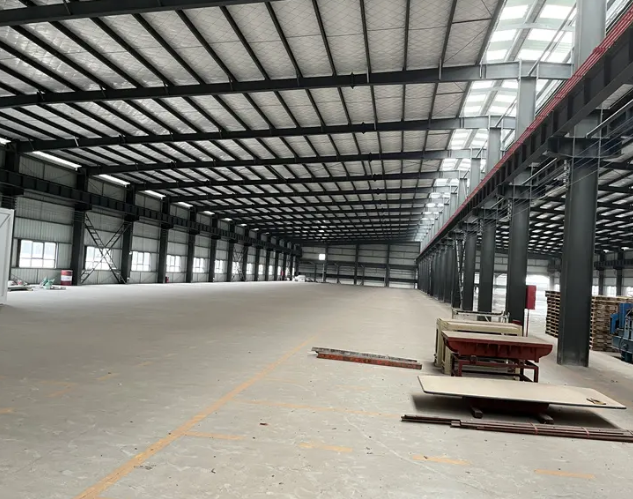
Clear-span steel workshop designs eliminate interior columns, delivering unobstructed floor space that directly enhances production efficiency and workplace safety in heavy-load environments. Without vertical obstructions, overhead cranes and automated guided vehicles operate freely—reducing cycle times and collision risks. This open layout also supports rapid reconfiguration of assembly lines in response to shifting product demands or custom machinery installations. A National Safety Council (2022) study found column-free zones reduce forklift-related incidents by up to 35%, largely due to improved operator visibility and maneuverability. Thanks to steel’s high strength-to-weight ratio, clear spans exceeding 30 meters are routinely achieved—even under heavy crane loads—without compromising structural integrity. This flexibility ensures the workshop remains operationally agile and future-ready, safeguarding productivity and safety across its full lifecycle.
Customizable Resilience Against Environmental and Operational Stresses
Seismic, Wind, and Thermal Adaptation in Heavy-Duty Steel Workshop Engineering
Heavy-duty steel workshops are engineered not as static enclosures but as responsive systems—capable of adapting to seismic, wind, and thermal stresses without compromising function or safety. In earthquake-prone regions, ductile moment-resisting frames and base isolation systems absorb and dissipate seismic energy, limiting damage to non-structural elements. For high-wind areas, aerodynamic shaping—combined with cross-bracing and rigid connections—distributes pressure evenly and resists uplift forces. Thermal expansion is managed through strategically placed expansion joints and sliding bearings that accommodate movement without inducing stress. High-strength steel alloys maintain performance across extreme ambient temperatures—from −30 °C to 50 °C—ensuring consistent behavior year-round. Crucially, these adaptations are site-specific: engineers calibrate damping ratios, wind load coefficients, and thermal allowances to local climate data and operational profiles. The outcome is a resilient, mission-critical facility—designed to sustain uninterrupted production and protect sensitive equipment, even under severe environmental stress.
Frequently Asked Questions (FAQs)
What is the significance of high-yield steel grades in industrial workshops?
High-yield steel grades like Q355, S355JR, and ASTM A572 offer superior load-bearing capability, enabling lighter frameworks, improved structural stability, and reduced steel tonnage compared to standard mild steel.
How do steel workshops handle fatigue-critical operations with cranes?
Fatigue-critical operations are managed through smooth structural transitions, reinforced welds, and using steel grades such as S355J2+N to reduce brittle crack propagation, ensuring structural longevity under cyclic stresses.
Why are integrated steel-concrete foundations preferred in steel workshops?
Integrated steel-concrete foundations provide better dynamic load distribution, reduce localized stress, minimize differential settlement, and offer adaptability for future upgrades in crane or machinery installations.
How do steel workshops manage vibration from overhead cranes?
Steel workshops utilize damping strategies such as bolted friction connections, viscoelastic dampers, and tuned mass dampers to mitigate vibrations, protecting structural integrity and operational efficiency.
What benefits do clear-span designs offer?
Clear-span designs eliminate interior columns, maximizing floor space, improving equipment maneuverability, and enhancing production efficiency while maintaining safety standards.
What adaptations ensure steel workshops are resilient in challenging climates?
Seismic, wind, and thermal stresses are managed through ductile frames, aerodynamic designs, base isolations, expansion joints, and high-strength steel alloys tailored to site-specific environmental conditions.
Table of Contents
- Superior Structural Capacity for Heavy Loads
- Robust Support for Heavy Machinery and Overhead Cranes
- Clear-Span Flexibility Enhancing Production Efficiency and Safety
- Customizable Resilience Against Environmental and Operational Stresses
-
Frequently Asked Questions (FAQs)
- What is the significance of high-yield steel grades in industrial workshops?
- How do steel workshops handle fatigue-critical operations with cranes?
- Why are integrated steel-concrete foundations preferred in steel workshops?
- How do steel workshops manage vibration from overhead cranes?
- What benefits do clear-span designs offer?
- What adaptations ensure steel workshops are resilient in challenging climates?