 EN
EN
Evaluate Steel Workshop Lighting Requirements
Illuminance Standards and Task-Based Light Levels for Steel Workshop Environments
Proper illuminance is foundational for safety, accuracy, and productivity in steel workshops. The Illuminating Engineering Society (IES) recommends 200–300 lux for general metalworking—such as material handling or rough fabrication—while precision tasks like welding inspection, metrology, or fine assembly require 500–750 lux (IESNA, 2011). These thresholds are evidence-based: a Lighting Research Center study found that raising average illuminance from 150 to 300 lux reduced visual fatigue complaints by 40% and improved defect detection by 22% (Lighting Research Center, 2020). In practice, this means zoning the space—e.g., 300 lux for high-bay cutting zones, 750 lux at calibrated measurement benches—rather than applying uniform light across the entire floor. Such task-based design avoids energy waste in low-activity areas while supporting OSHA’s general duty clause for hazard-free workplaces. Uniformity also matters: maintain a minimum-to-average illuminance ratio above 0.6 to prevent disorienting brightness contrasts.
How Steel Structure Geometry Affects Light Distribution, Reflection, and Shadow Control
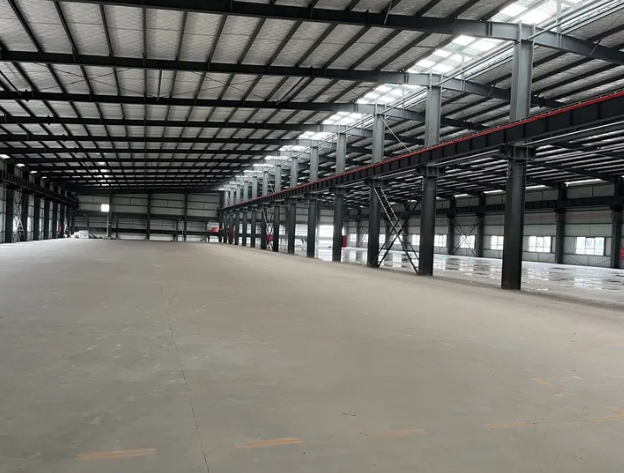
A steel workshop’s structural geometry fundamentally shapes lighting performance. Deep beams, open-web trusses, and tall columns obstruct direct light—up to 30% of downward flux can be blocked by joists alone (Lighting Design Lab, 2019). Fixtures mounted above the lower chord of trusses—or fitted with asymmetric optics—help route light around obstructions. Surface reflectance further influences efficiency: bare steel reflects only 20–40% of incident light, whereas galvanized corrugated roof decks reflect up to 60%, contributing useful indirect illumination. To compensate for low wall reflectance, designers often specify higher-output fixtures or pair them with reflective ceiling panels. Orientation matters too: aligning luminaires parallel to long truss spans minimizes beam interruption. Photometric modeling using the workshop’s actual 3D geometry allows precise prediction of shadow patterns, enabling layouts that deliver consistent, glare-free coverage—even in complex, column-dense environments.
Choose High-Efficiency LED High Bay Lights for Steel Workshop Applications
Why LED High Bay Fixtures Outperform HID in Steel Workshop Lighting
For steel workshops with ceilings often exceeding 20 feet, LED high bay fixtures outperform legacy HID systems in every critical dimension. Unlike metal halide lamps—which require 5–10 minutes to reach full output—LEDs deliver instant, full-intensity light, eliminating visibility gaps during shift changes or emergency response. They cut energy use by up to 75%, maintain over 70% of initial lumens at 50,000+ hours (versus HID’s 30% lumen loss within 5,000 hours), and operate reliably in cold, unheated spaces where HID struggles to start. Directional LED optics enable precise beam control—reducing shadows cast by steel beams and machinery—while robust housings resist dust, vibration, and thermal cycling common in fabrication settings. Research links these advantages to tangible safety gains: studies show improved LED lighting reduces workplace accidents by 15–25% through enhanced contrast sensitivity and reduced glare (Lighting Research Center, 2020).
Design a Precision Lighting Layout for Your Steel Workshop
Calculating Mounting Height, Spacing, and Beam Angle for Uniform Steel Workshop Illumination
Effective layout starts with three interdependent variables: mounting height (MH), fixture spacing, and beam angle. MH is measured from the fixture to the work plane—typically 30 inches (0.76 m) above the floor. For LED high bays in steel workshops, a spacing-to-mounting-height (S/MH) ratio of 1.0–1.5 ensures uniform coverage without dark zones or excessive overlap. At 20 ft (6 m) MH, for example, fixtures should be spaced 20–30 ft apart. Beam angle selection must then match this geometry: narrow beams (60°–90°) suit high-mounting applications like main aisles or tall-roofed fabrication zones; wider 120° distributions better serve lower-ceiling assembly areas. Asymmetric optics (e.g., 30°/60°) excel at wall-washing or aisle lighting, reducing dark corners. Poorly coordinated spacing and beam angles can degrade uniformity by over 40%—wasting light on walls or creating hazardous hotspots.
| Beam Angle | Typical Mounting Height | Best Application in Steel Workshop |
|---|---|---|
| 60° – 90° | > 20 ft (6 m) | High-rack storage, main aisles, general illumination under tall roofs |
| 120° | 10 – 20 ft (3 – 6 m) | General assembly, low-ceiling fabrication areas, open floor plans |
| Asymmetric (e.g., 30°/60°) | Varies | Aisle lighting, perimeter lighting along walls to reduce dark corners |
Balancing Uniformity and Task-Specific Zoning in Steel Workshop Layouts
Uniform ambient light provides a safe baseline—but true efficiency comes from strategic task zoning. Begin with a general grid delivering ~200 lux across the entire floor, then layer targeted supplemental lighting where work demands more: 150 lux for storage, 500 lux for welding stations, 750 lux for quality inspection. This approach avoids over-lighting non-critical areas—potentially cutting lighting energy use by up to 30% (IES Handbook, 2023). Crucially, transitions between zones must be gradual. Abrupt shifts in illuminance cause eye strain and visual disorientation as workers move between areas—a real safety risk near heavy machinery. Smart controls (e.g., occupancy sensing, daylight harvesting, and zonal dimming) make this layered strategy operationally practical and scalable across large, open steel structures.
Maximize ROI with Professional Steel Workshop Lighting Design Support
Professional lighting design transforms illumination from a utility into a strategic asset. Experts optimize fixture type, mounting configuration, optical distribution, and control integration—not just for compliance, but for durability, energy efficiency, and operational resilience. In harsh steel workshop environments—where vibration, airborne metal particulates, and wide temperature swings accelerate wear—specifying purpose-built fixtures prevents premature failure and unplanned downtime. A tailored design avoids costly errors: improper spacing that creates dangerous shadows, undersized optics that compromise task visibility, or over-specified systems that inflate capital and operating costs. The result is measurable ROI: lower kWh consumption, extended maintenance intervals, fewer replacements, and demonstrably safer working conditions—all contributing directly to the workshop’s productivity and bottom line.
FAQ
What is the recommended illuminance level for steel workshops?
The recommended illuminance levels vary based on tasks: 200-300 lux for general metalworking, and 500-750 lux for precision tasks like welding inspection or fine assembly.
Why are LED high bay lights better for steel workshops?
LED high bay lights offer instant full output, use 75% less energy, last longer, and provide directional beam control, making them ideal for steel workshops.
How does steel workshop geometry affect lighting design?
Structural components like beams and trusses obstruct direct light. Adjusting fixture placement, using reflective surfaces, and photometric modeling help optimize light distribution and reduce shadows.
What is a good layout strategy for steel workshop lighting?
A good layout combines a general grid providing ~200 lux and tasks-specific zoned lighting. Gradual transitions between zones avoid strain and ensure safety.
How does professional lighting design maximize ROI?
Professional design integrates durable fixtures, strategic layouts, and energy-efficient controls, reducing maintenance costs, energy usage, and workplace risks.